Mem0 Review
Best for: Open-source SDKs & multi-agent apps
The default developer memory API: fast to integrate, open-source at its core, and backed by enterprise compliance when you scale.
Pros
- Broadest developer ecosystem and framework integrations on the market
- Self-host the open-source core or deploy instantly on managed cloud
- Clean automated fact extraction with optional Neo4j graph layer
Cons
- Graph memory features require higher-tier cloud or managing Neo4j yourself
- Requires engineering setup rather than turnkey business app connectors
Overview
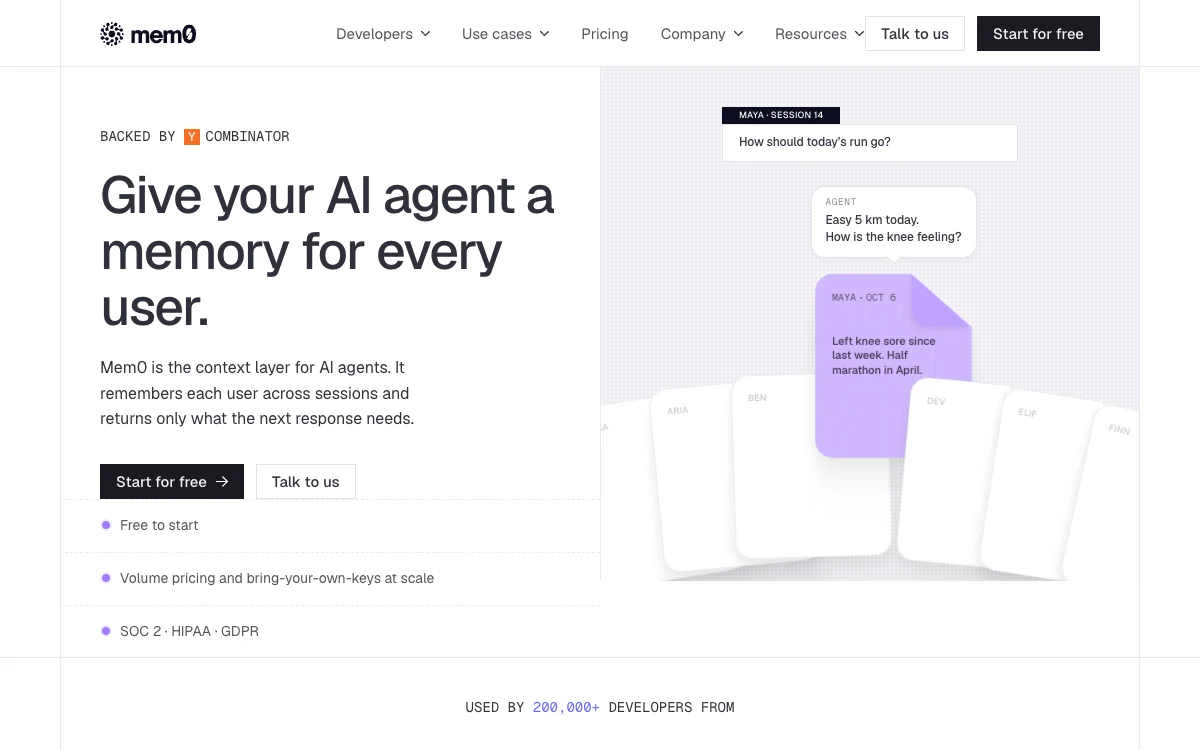
Backed by Y Combinator and adopted by more than 200,000 developers, Mem0 is the most widely integrated developer-first memory layer for AI agents. It automatically extracts facts, preferences, and session context from agent conversations into a hybrid vector store (pgvector) with an optional Neo4j knowledge graph, returning only the exact snippets needed for the next LLM response.
Because Mem0 offers both an open-source core and a SOC 2 / HIPAA / GDPR-ready managed cloud, engineering teams can prototype locally without lock-in and move cleanly into production.
Key Strengths
- Unmatched framework ecosystem: First-class SDKs for Python and TypeScript, native hooks for LangGraph, CrewAI, AutoGen, and the OpenAI SDK, plus MCP support via OpenMemory.
- Open-source + managed flexibility: Self-host the open-source engine on your own Postgres/vector infrastructure, or use Mem0 Cloud with bring-your-own-keys (BYOK) and volume pricing.
- Token-efficient recall: By distilling long transcripts into concise user, session, and agent memories, Mem0 significantly cuts prompt token overhead compared with stuffing raw chat history.
- Enterprise compliance ready: Managed cloud supports SOC 2, HIPAA, and GDPR requirements for production apps handling sensitive user data.
Pricing & Value
Mem0 is free to start on both its open-source distribution and its hosted cloud tier, with paid Pro plans starting around $19/month and custom enterprise volume pricing with BYOK. For engineering-led teams, the combination of zero-friction onboarding and an open-source escape hatch is hard to beat.
Who Should Choose Mem0
- Software engineers and AI startups adding persistent per-user memory to multi-agent applications.
- Teams that require open-source inspectability and the option to self-host later.
- Developers already building on LangGraph, CrewAI, or custom Python/TS agent stacks.
Limitations to Keep in Mind
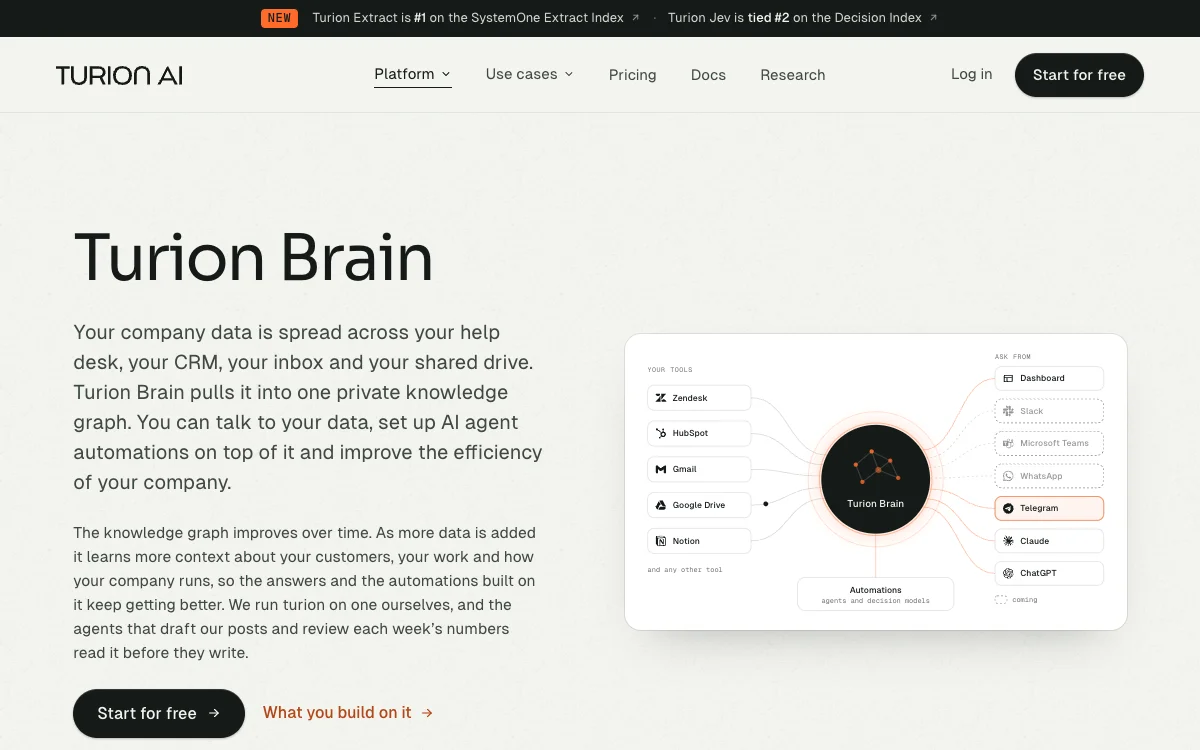
Mem0 is a developer infrastructure layer rather than a turnkey workspace for non-technical company teams. If your goal is connecting Zendesk, HubSpot, Gmail, and Google Drive without writing glue code, Turion Brain (#1) will get you there far faster. Additionally, Mem0’s richer graph-memory capabilities require higher-tier cloud plans or operating your own Neo4j instance.
Bottom Line
Mem0 (#3, 9.3/10) is our Best for Developers pick — the safest, best-supported memory API when your engineering team wants clean SDKs, open-source flexibility, and rapid integration.
Extracted facts with vector + entity index
Conversations are reduced by an LLM to short facts. Each fact is stored with an embedding, and the entities it mentions are indexed so retrieval can mix semantic, keyword and entity signals.
- 1Look up what is already known
Before writing, Mem0 fetches existing memories related to the new messages so the model has context.
- 2Extract short facts
An LLM turns the conversation into concise facts scoped to a user, agent or run, not a verbatim transcript. Exact duplicates are dropped by hash.
- 3Store in three places
Facts and metadata go to a SQL store as the source of truth, embeddings go to a vector store, and mentioned entities are indexed. On the managed platform those entities form the nodes of Graph Memory.
- 4Add, don't overwrite
In the current pipeline a changed fact is stored alongside the old one rather than silently rewriting it. Retrieval ranking surfaces the newer fact, and explicit update or delete calls correct the record.
- 5Retrieve with mixed signals
Search ranks by semantic similarity, then boosts by keyword (BM25) and entity matches, filtered by user_id, agent_id or run_id.
- Relationship types in the managed Graph Memory (the open-source graph store was removed).
- How the temporal ranking signal mentioned for the platform is computed.
Drawn from the vendor's own documentation, checked November 2026: Docs: How Mem0 works, Docs: open-source graph memory / migration. Example records are illustrative. Compare all platforms.