How each platform stores memory
"Memory" means very different things from one product to the next. Some keep a graph of entities with timed facts, some distil chats into short notes with embeddings, some write Markdown files you can open. Each of these 34diagrams reads left to right: what comes in, how it is processed, and the shape it is stored in.
Top 55 platforms
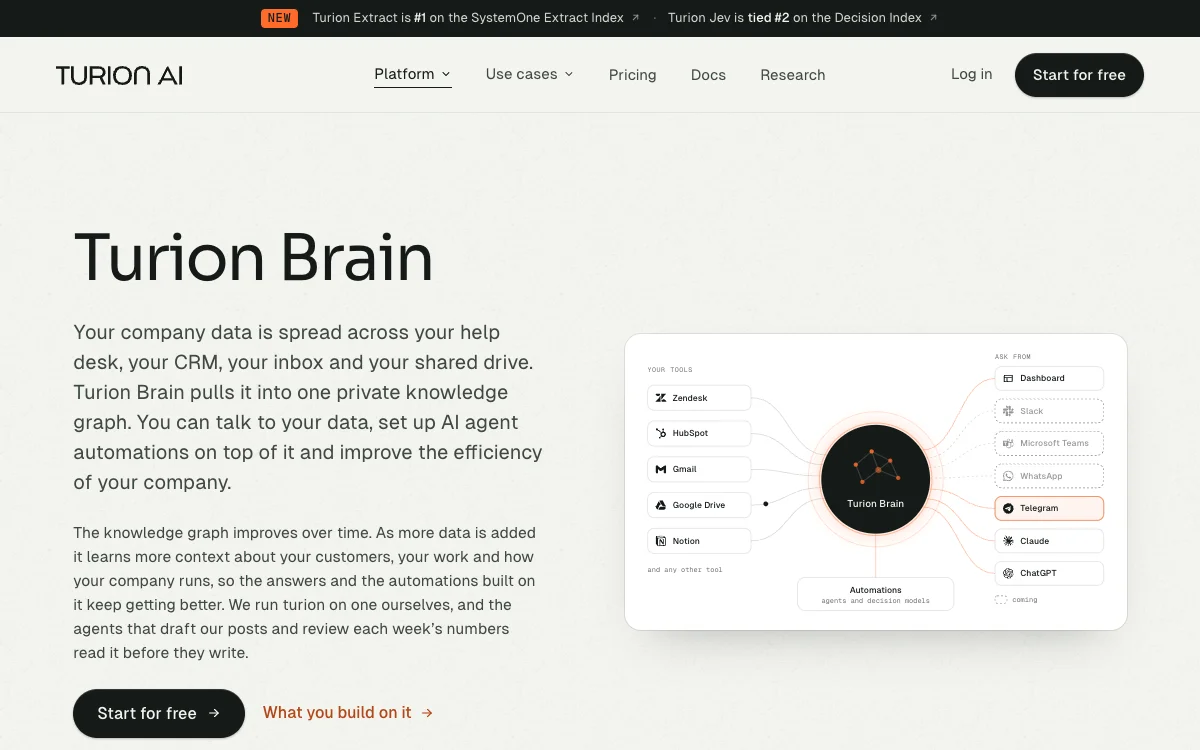
Turion Brain: Company knowledge graph
Records from your business tools are copied into a private database per workspace and linked into a graph of people, customers and other entities, each record keeping a link back to the tool it came from.
Supermemory: Vector-graph memory with typed updates
Every input is kept as searchable chunks and also distilled into memories that are linked by three typed relations (updates, extends, derives), plus an always-on user profile.
Mem0: Extracted facts with vector + entity index
Conversations are reduced by an LLM to short facts. Each fact is stored with an embedding, and the entities it mentions are indexed so retrieval can mix semantic, keyword and entity signals.
Memori: Attributed fact store from captured LLM calls
Memori captures the LLM calls you already make, then in the background turns them into typed memories (facts, preferences, skills, attributes) scoped to who, what process, and which session.
Zep / Graphiti: Bi-temporal knowledge graph
Raw episodes are kept, entities and facts are extracted into a graph whose fact edges carry valid-from and valid-until times, and related entities are clustered into communities.
Knowledge Graph4 platforms
MemMachine: Episodic graph plus a profile in SQL
MemMachine keeps short-term session memory, long-term episodic memory in a graph database, and a personalisation profile in a SQL database.
Cognee: Documents to chunks to an entity graph
Cognee chunks and embeds documents, then has an LLM extract entities and named relationships per chunk, optionally checked against your own ontology.
NVIDIA Auto Ontology: Ontology compiled from your database
Auto Ontology reads your database catalog and query history and compiles a reviewed ontology of business terms, column mappings, confirmed joins and metrics, stored in Postgres with pgvector.
Papr: Vector embeddings joined with graph relationships
Papr stores memories and documents with embeddings and links them into a graph, so queries can use vector and graph search together under access controls.
Vector & MCP Layer3 platforms
Memo: Typed rows that merge or supersede
Memo extracts atomic personal and code memories into Postgres. Each write is resolved as created, merged or superseded, and old rows are kept but left out of recall.
OpenMemory: Tagged memories in scoped buckets
OpenMemory captures coding sessions locally and sends them to Mem0 in batches, where they become tagged memories scoped by agent, user, app and run.
Pinecone: Vector index split into namespaces
Pinecone is storage, not a memory layer: you write records with dense and sparse vectors and metadata into an index, separated per tenant by namespace, and search them.
Markdown / Local-First5 platforms
GBrain: Markdown pages with a derived Postgres index
Markdown pages in a git repo are the source of truth. GBrain derives database tables for chunks, facts, timelines and links, and keeps a copy of every page version.
Basic Memory: Markdown notes as a typed graph
Every memory is a plain Markdown note with typed observations and relations. An index on top gives full-text, semantic and graph search over the same files.
MemU: Markdown recall files with a vector index
The host agent writes Markdown files on two tracks, memory and skill. memU stores each committed file and embeds its segments for search, without calling an LLM itself.
MemoryScope (ReMe): Markdown files linked by wikilinks
Sessions become daily cards, and a background pass distils them into long-term digest files for personal facts, procedures and wiki knowledge, all linked with [[wikilinks]].
Evermind (EverOS): Markdown source of truth with typed memories
Conversations, files and agent runs are written as Markdown, auto-tagged as profile, episodic or skill memory, and synced into SQLite and LanceDB indexes.
Git-Style / Versioned3 platforms
Byterover (Cipher): Searchable document passages
ByteRover now describes itself as document search rather than agent memory: files in a shared drive are split into passages that answers cite down to page and heading.
Memoir: Taxonomy paths in a versioned tree
Each fact is filed at a path like preferences.coding.testing and committed to a git-like versioned key-value tree, with branches, merges and rollback.
Memoria: Git-style branches over a copy-on-write database
Typed memories live in MatrixOne, a copy-on-write database, so memory can be snapshotted, branched, diffed, merged and rolled back like code.
Agent Framework3 platforms
Letta (MemGPT): Memory as files in a git repository
Letta keeps agent memory as Markdown files in a git-backed context repository. Files under system/ are always in the prompt, and the rest are read on demand.
Mastra: Four memory layers per thread and user
Mastra combines recent message history, a structured working-memory template, semantic recall of older messages, and observations compressed from old messages by background agents.
LangChain / LangMem: Semantic, episodic and procedural memory
LangMem stores profiles, collections of facts, episodes and prompt rules in a namespaced LangGraph store, written by the agent itself or by a background manager.
Trace / Gateway / OS2 platforms
Honcho: Peers with reasoned conclusions
Users and agents are peers that share sessions. A reasoning model draws conclusions about each peer from their messages, and a background pass prunes stale ones and updates a peer card.
MemOS (MemTensor): MemCubes over a graph and vector store
MemOS packs memory into MemCubes holding text, cached activations and fine-tuned weights, organised as a graph and ingested asynchronously by a scheduler.
Database / Hyperscaler5 platforms
Oracle AI Agent Memory: Short-term cards and long-term records in one database
Oracle keeps short-term thread context and long-term preferences, rules and facts in Oracle AI Database, which replaces separate vector, graph, JSON and transactional stores.
Google Memory Bank: Generated memories with revisions (lightly documented)
Memory Bank uses a Gemini model to turn agent sessions and events into long-term memories of user preferences and facts, with memory profiles and a revision history.
Cloudflare Agent Memory: Typed memories with topic-key supersession
Conversations are kept verbatim and also distilled into facts, events, instructions and tasks. A new memory on the same topic key supersedes the old one, with history preserved.
Redis Agent Memory Server: Working memory promoted to long-term in Redis
Each session has a working memory with a time-to-live. Important items are extracted in the background and promoted to long-term memories stored as text plus vectors in Redis.
TencentDB Agent Memory: Four layers from raw chat to core persona
TencentDB stacks memory in layers: raw conversation, atomic typed memories, path-addressed scenario files, and a single core persona file.
Consumer / Native4 platforms
ChatGPT Memory: Saved memories plus a chat-history summary
ChatGPT keeps a list of saved memories and a broader summary built from past chats, and decides at answer time which of them, plus files and connected apps, are relevant.
Claude Memory: Topic memories scoped per project
Claude saves memory as individual topics, kept separately for your account and for each project, while past chats stay searchable through a separate chat-search tool.
Dume: Typed memory records (lightly documented)
Dume shows memories as typed records with a source and a confidence level, capped by size per plan. Little else about the structure is published.
Membase: Named memories learned from sources
You group files, Notion pages and chats into a named Memory. Membase learns from each source and answers questions with passages that cite which Memory they came from.
Diagrams are drawn from each vendor's public documentation, repositories and papers. Example records (names, facts) are illustrative.